
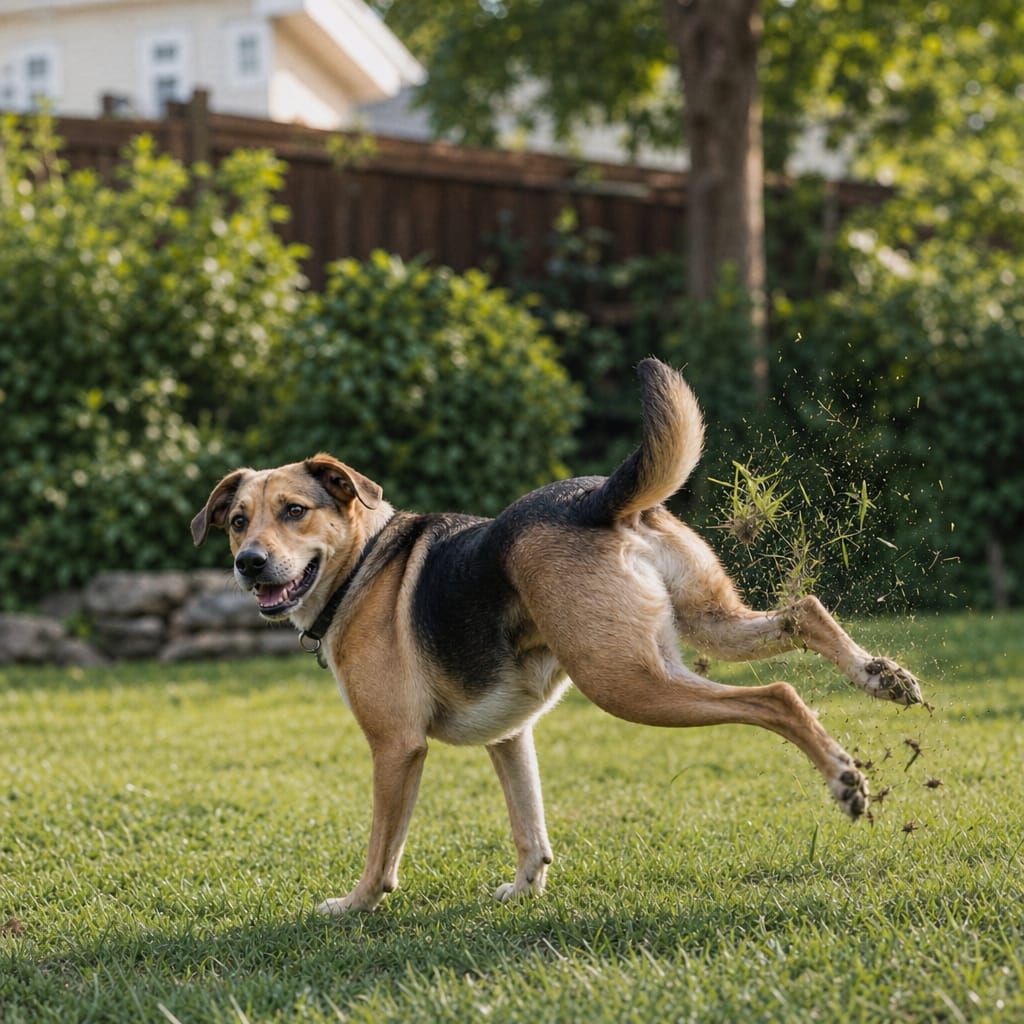
Your dog finishes pooping, takes two proud steps forward, then starts kicking dirt and grass behind them like they are trying to tear up the whole yard. It looks dramatic. It can be messy. And if you have ever wondered whether your dog is trying to bury the poop, mark territory, or just show off a little, the short answer is this:
They are not trying to cover it up. They are usually trying to leave a stronger message behind.
That post-poop kicking behavior is commonly called ground scratching. It is a normal dog behavior tied to scent communication, and it is one of those little things that makes a lot more sense once you understand how dogs experience the world.
Your Dog Is Not Trying to Bury the Poop
This is the biggest misconception.
Cats bury waste to hide it. Dogs kicking after pooping are usually doing the opposite. They are making the area more noticeable.
When dogs scrape the ground with their back feet, they are not just flinging dirt. They are also leaving scent from the paws while disturbing the ground enough to create a visible mark. As PetMD explains in its ground-scratching overview, this behavior is widely understood as a mix of scent communication and visual signaling rather than an attempt to clean up the area.
So if your dog kicks up half the lawn after pooping, they are not being rude or confused. They are basically adding emphasis.
Why Dogs Do It
Dogs rely on scent far more than we do. A patch of grass that seems meaningless to you can be packed with information to another dog.
After pooping, a dog has already left one scent signal behind. Kicking the ground adds another one. The behavior may help:
- spread scent from the paws across the ground
- leave a stronger territorial marker
- create a visual sign for other dogs
- add a social signal in places where lots of dogs pass through
PetMD notes that dogs often use ground-scratching as part of scent-marking, especially when other dogs are around or likely to pass through the area. In other words, your dog may be saying, “I was here,” in the most dog-like way possible.
It Is Part Scent, Part Signal, Part Instinct
This behavior tends to stick around because it works on more than one level.
First, there is the scent component. Research in Scientific Reports on pedal scent recognition in domestic dogs supports the basic idea that dogs can gather information from scent associated with the feet and interdigital regions, which helps explain why scratching the ground can function as part of scent communication.
Second, there is the visual piece. Torn-up grass or disturbed dirt leaves a mark that other dogs can notice.
Third, there is instinct. Wild canids use similar marking behaviors, and domestic dogs have kept many of those routines even when they are living in fenced yards and sleeping on memory-foam beds.
So the kicking may look chaotic, but from your dog’s perspective it is pretty purposeful.
Why Some Dogs Do It More Than Others
Not every dog kicks after pooping. Some do it every single time. Some only do it in certain spots. Some never do it at all.
That variation is normal.
PetMD cites Marc Bekoff’s 1979 observations of free-ranging dogs, which found that ground-scratching was more likely when other dogs were physically present. Confidence, excitement, habit, and environment can all play a role. One dog may quietly poop and move on. Another may act like they are closing out a championship game.
Breed and sex do not explain it neatly. Both males and females can do it. Big dogs and little dogs can do it. The behavior is more about the individual dog and the context than some simple rule.
Is It a Problem?
Usually, no.
For most dogs, kicking after pooping is harmless, normal, and nothing you need to stop. If your dog is scratching around in soft grass or dirt and nobody is getting showered in debris, it is usually fine to let them finish their little ritual.
Where it becomes annoying is when your dog:
- tears up your lawn
- kicks mulch into flower beds
- sprays dirt onto your legs
- does it on rough ground and starts irritating their paws
If that is happening, you do not need to punish the behavior. A simple redirect works better. Once your dog finishes pooping, calmly cue them forward and keep walking before the scratching starts. In a Live Science interview with veterinary behaviorist Carlo Siracusa of the University of Pennsylvania School of Veterinary Medicine, he noted that trying to shut the behavior down entirely can leave dogs feeling more vulnerable because you are cutting off one of their communication channels with other animals. The goal is not to make them feel wrong for doing something instinctive. It is just to interrupt the lawn-destruction phase.
When You Should Pay Attention
The kicking itself is usually not a medical issue.
What matters is everything around it.
Talk to your vet if you notice:
- straining to poop
- yelping or signs of pain
- blood in the stool
- diarrhea or major stool changes
- sudden new compulsive behavior around pooping
- paw damage from repeated scraping
Those things are worth paying attention to, but they are separate from the normal communication behavior itself.
If your dog has always done a quick kick after pooping and seems perfectly happy, that is usually just your dog being a dog.
The Bottom Line
When your dog kicks after pooping, they are usually not trying to bury the evidence. They are more likely leaving behind a stronger scent and visual signal for other dogs.
It is messy, a little ridiculous, and completely normal in most cases.
So the next time your dog launches dirt behind them like they are celebrating a personal achievement, they kind of are. They finished the job and made sure the neighborhood knows it.

Samantha Tilton
I catch the things that are easy to miss. The small changes, the quiet signs, the details hiding in plain sight. I co-founded The Daily Dog because the best thing you can do for your dog is pay attention, and I write to help you know what to pay attention to.
